

The construction industry has seen a remarkable transformation recently. Modern engineering techniques, new technologies, and innovative materials have altered the design and construction of buildings. As a result, discussions about modular vs. traditional construction have become more common among homeowners, developers, and industry professionals.
The building industry has depended on traditional construction methods for generations. But recent construction techniques, such as modular construction, are gaining attention for their speed, efficiency, and controlled building processes. While both methods aim to create durable, functional structures, they differ significantly in their construction processes, timelines, flexibility, and cost management.
Understanding the differences between modular and traditional construction can help property owners make informed decisions when planning a new home or building project. Experienced builders in Coimbatore often emphasize that each method has its advantages, and the right choice often depends on the project’s goals and requirements, including budget constraints, desired completion time, and the property owner’s specific needs.
Traditional construction, frequently referred to as on-site construction, is the most commonly used building method. In this method, the entire construction process takes place at the building site. Workers construct the structure step by step, starting with foundation work and slowly progressing through walls, floors, roofing, and finishing stages.
Materials such as cement, bricks, steel support, and concrete are transported to the construction site and assembled there. Each stage of the construction process must be completed before the next stage begins, making traditional construction a continuous process.
Traditional construction offers several advantages that have made it the preferred building method for many years:
However, the process may take longer because every stage of construction depends on the previous one’s completion. Additionally, weather conditions such as rain or extreme heat can delay progress on-site.
Considering all of these challenges, traditional construction remains a reliable method for building customized homes and visually complicated structures.
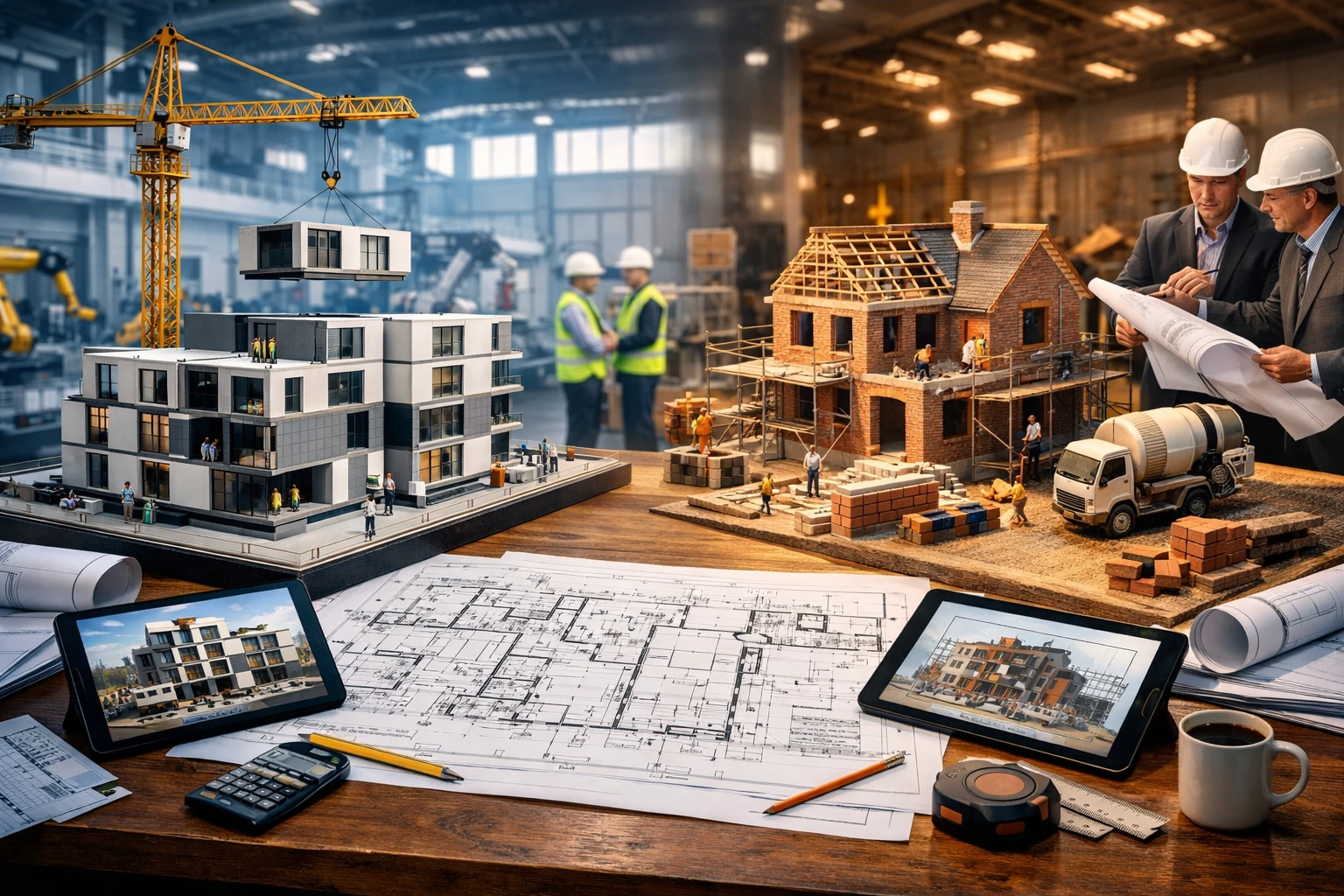
Modular construction represents a new approach to building structures. Instead of constructing everything directly on-site, buildings are created using assembled sections known as modules. These modules are manufactured in a factory-controlled environment and later transported to the construction site for final assembly.
Each module is designed to fit together with others, forming the completed building structure. The modules frequently include walls, floors, electrical wiring, plumbing systems, and interior finishes before they even reach the site.
This approach shows how modular vs. traditional construction methods differ greatly in terms of efficiency and workflow.
Key Characteristics of Modular Construction
Modular construction offers several different benefits:
Because modules are built in factories while site preparation occurs in parallel, modular construction can greatly reduce the total project timeline, often resulting in completion times that are weeks or even months shorter than traditional construction methods.
Recently, modular construction has gained popularity in residential, commercial, and even large-scale infrastructure projects due to its efficiency and scalability.
Modular construction represents a new approach to building structures. Instead of constructing everything directly on-site, buildings are created using assembled sections known as modules. These modules are manufactured in a factory-controlled environment and later transported to the construction site for final assembly.
Each module is designed to fit together with others, forming the completed building structure. The modules frequently include walls, floors, electrical wiring, plumbing systems, and interior finishes before they even reach the site.
This approach shows how modular vs. traditional construction methods differ greatly in terms of efficiency and workflow.
Key Characteristics of Modular Construction
Modular construction offers several different benefits:
Because modules are built in factories while site preparation occurs in parallel, modular construction can greatly reduce the total project timeline, often resulting in completion times that are weeks or even months shorter than traditional construction methods.
Recently, modular construction has gained popularity in residential, commercial, and even large-scale infrastructure projects due to its efficiency and scalability.
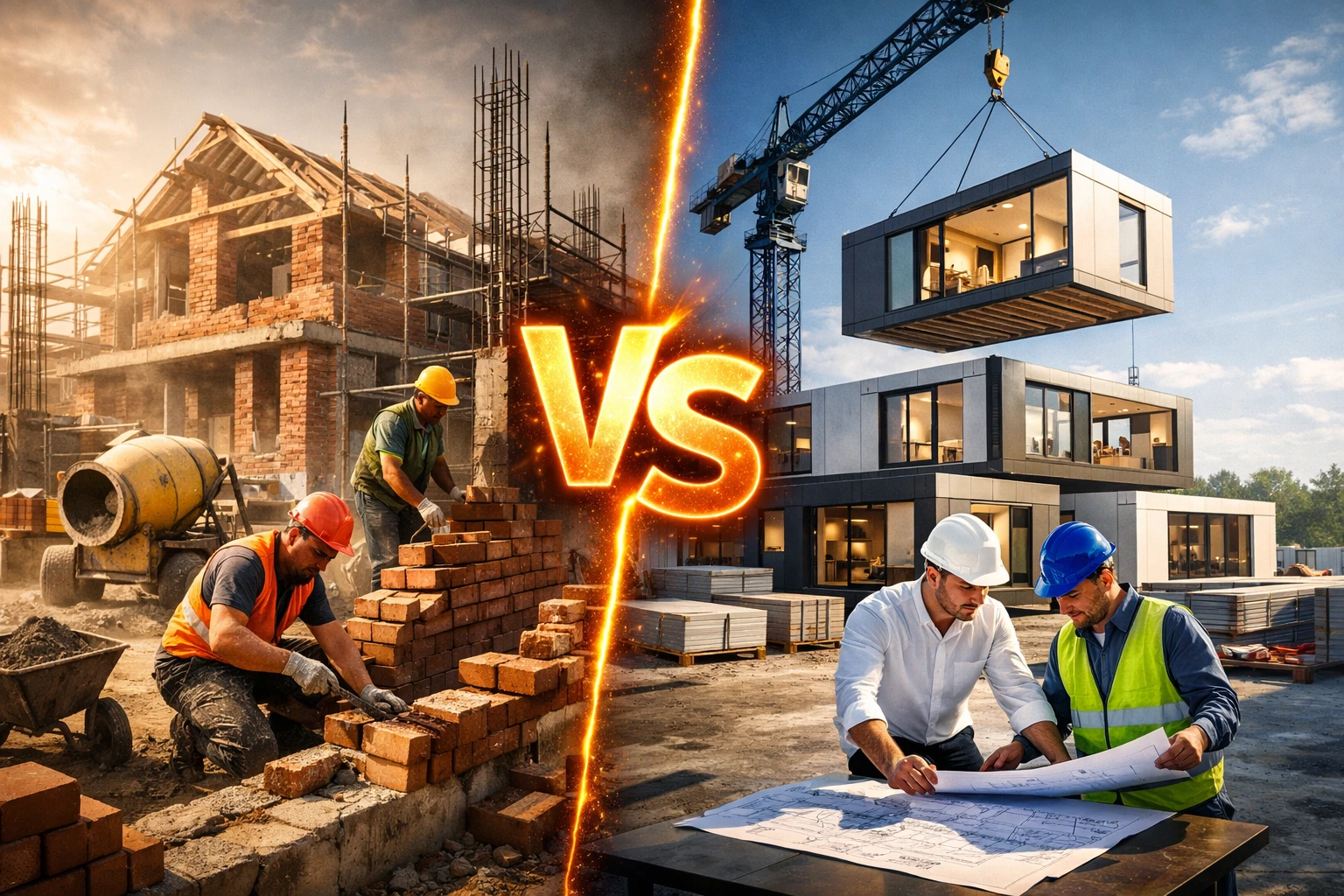
| Aspect | Modular Construction | Traditional Construction |
|---|---|---|
| Construction Timeline | Different stages happen at once. Modules are built in factories while site preparation takes place, which greatly reduces the total construction time | Construction follows a step-by-step process where each stage must be completed before the next begins, which can extend the overall project duration |
| Construction Environment | Most work is completed in controlled factory environments, which helps avoid weather-related delays and maintains identical quality standards | Construction takes place entirely on-site and outdoors, making the process more dependent on weather conditions like rain, wind, or extreme temperatures |
| Design Flexibility
|
Modular construction usually follows standard module sizes and layouts. While some modification is possible, design adaptability may be more limited | Traditional construction allows greater design freedom. Architects and builders can modify layouts, dimensions, and features during the building process |
| Cost Efficiency | Factory production, reduced material waste, and shorter construction timelines often make modular construction more cost-effective for many projects | Longer timelines, higher labor requirements, and potential delays can increase overall construction costs |
| Quality Control | Factory-controlled production processes ensure consistent quality, precise measurements, and strict quality checks using advanced machinery | Quality largely depends on the skills of on-site workers and supervision by engineers and contractors during the construction process |
Sustainability has become an important focus in the construction industry. Builders are increasingly looking for methods that reduce environmental impact while maintaining high structural quality.
Modular construction often produces less material waste because components are manufactured with exact measurements in factory settings. Efficient resource management also reduces excess material use.
Traditional construction may produce more waste due to on-site material cutting and adjustments. However, nowadays construction companies are implementing sustainable practices such as recycling materials, improving energy efficiency, and using environmentally friendly building materials.
As the industry evolves, both modular and traditional construction methods are being adapted to support more ecologically friendly building practices.
The choice between modular and traditional construction depends on several important factors related to the project’s design, timeline, and overall requirements. Understanding these elements can help homeowners choose the most proper construction method.
Traditional construction is frequently preferred for projects that involve difficult architectural designs or highly customized layouts. It provides greater adaptability for unique structures and design adjustments during the building process.
Modular construction can significantly reduce the overall building timeline. Since parts are manufactured in factories while site preparation happens in parallel, the final assembly can be completed much faster.
Modular construction may offer better cost efficiency because of reduced labor requirements and optimized material usage. Shorter construction timelines can also help reduce overall project expenses.
Homeowners who want unique layouts or specialized architectural features frequently prefer traditional construction. This method allows more customization and variation in design compared to modular structures.
In order to produce effective and long-lasting structures, many modular construction firms combine the advantages of both approaches, combining innovative building technologies with traditional craftsmanship.
Understanding the differences between modular vs. traditional construction helps homeowners make better decisions when planning a building project. Traditional construction offers adaptability and detailed workmanship, while modular construction focuses on speed and efficient building processes. Brick by Brick Works focuses on delivering well-planned construction projects by combining modern building methods with strong structural practices, ensuring homes are built with both durability and thoughtful design.
 Quality & Efficiency
We manage interior, commercial, industrial, and residential projects from conception to conclusion.
We deploy premium, long-lasting, and environmentally friendly materials that are customised to meet the unique needs of your project.
Project schedules differ according to site circumstances, design, scope, approvals, and material availability.
Yes, we provide completely personalised building solutions that are suited to your unique requirements and goals.
Yes, we oversee all required approvals and permits to ensure a seamless building process.
We specialize in Residential, Commercial, and Industrial construction, along with expert Interior design services.